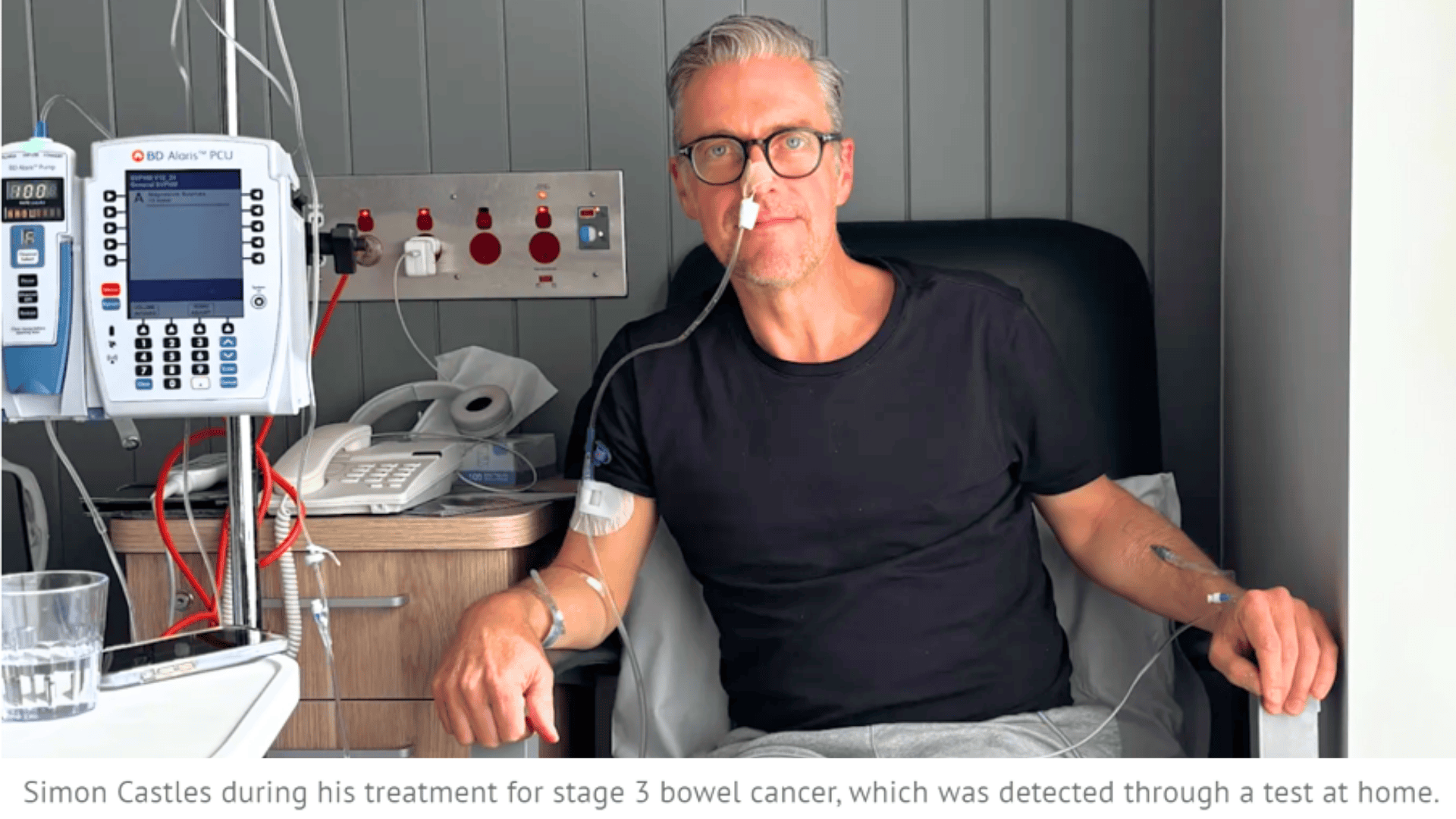
On 7 June, Simon Castles wrote an opinion piece in the Sydney Morning Herald explaining how the government bowel screening kit helped discover his bowel cancer, and how he now uses exercise to help reduce the risk of recurrence.
At age 54, a colonoscopy identified a 2 cm stage 3 tumour. Bowel surgery followed two weeks later. You can read Simon’s story in the Sydney Morning Herald.
What advice did his cancer doctor give him?
Exercise.
His doctor cited research known as the CHALLENGE Trial, an international phase III clinical trial looking at structured exercise following treatment for colon cancer.
The study followed nearly 900 patients for 3 years with stage III or high-risk stage II colon cancer who had already completed standard surgical removal and chemotherapy.
Participants in the exercise group followed a structured program for three years. The results showed:
- a 28% lower risk of disease recurrence, a new primary cancer or death
- a 37% lower risk of death compared with the health education group
- improvements in physical functioning and fitness.
You can read the CHALLENGE Trial in the New England Journal of Medicine.
Why wait?
Historically, physical activity has often been seen as a “nice-to-have” way of helping cancer survivors manage fatigue and maintain their wellbeing.
The CHALLENGE Trial provides strong evidence that structured exercise can play an important role in care following treatment for colon cancer.
But why wait until you have cancer?
Common sense and good ageing say there’s every reason to make regular exercise part of your life now.
And when it comes to bowel cancer screening, use the free test when it’s available to you. Australians aged 45 to 74 are eligible for the National Bowel Cancer Screening Program. People aged 45 to 49 can request a free kit, while those aged 50 to 74 are mailed one every two years.
Learn more about the National Bowel Cancer Screening Program.
Monday Club can be your investment in good ageing, building strength, movement and confidence for the years ahead.